Month: January 2009

  • How much psychology is involved in meteorology?

    For more than a week, the three-day weather forecasts have been offering the promise of above zero temperatures three days ahead.  In this era of climate change, I know that predicting weather is more challenging than ever.  The tendency some people have to blame the messenger who brings bad news only makes a weatherman's job more complicated.  A need or desire to make accurate prognostications is fraught with peril enough all by itself.  Wanting to do so without causing distress or panic could set up some powerful psychological binds for the weather people, even before climate change nullified all their old algorithms.

    I imagine a scene where several meteorologists are looking at the data.  They see how it is and assume, based on previous experience, that it can either go this way or that way.  Of course, they have a responsibility to warn of dangerous storms, etc., but they might also feel they have some responsibility to reassure or encourage people.   If this is a rainy summer or extraordinarily frigid winter, wouldn't they tend to say it would do that, just to prevent personal despair or public panic in the populace?  And what do they do then, if the weather finds some other way to go?

    I have been thinking about this since last summer, when I kept hearing promises that the rain would stop and the sky would clear within a few days.  It never happened.  It rained here all summer and into the fall, when the rain turned to snow.  The weather people said we would have a mild winter, which I took to mean warm, which would, in the normal course of events, have meant lots of snow.

    We did have more than normal snowfall in October, November, and December.  But January's seemingly endless cold spell has blown that "mild winter" idea all to pieces.  Today's three-day forecast says a high of 6° F above zero tomorrow, and a low of -23° F.  Monday it is supposed to be snow with a low of 4° F and a high of 22° F, and Tuesday, more snow with a low of 8° F and high of 26° F.  Dare I believe that?  More importantly, if it's true, will one day of that temperature be enough for my car to warm up to a temperature where it will start, and will so much snow fall in two days that I'll have to wait for the plow to come around before I can get out of the driveway?

    It is -34° F outside now, and was only 44° F in the house when I woke this morning.  Doug had been poking and rearranging a fire of knotty irregular wood that was reluctant to burn.  With some chips of kindling, I got it burning, but the dog had to go out and Doug needed to empty some ashes I'd shoveled from the stove and the pee bucket that keeps me from having to use the outhouse in this weather, as well as bringing in three armloads of wood before stuffing the insulating plastic bags back into the gaps around the door.  It is now 45° F in here, six degrees warmer than the inside of the fridge.  The tropical plants aren't happy, but they're hanging in there.

    We can still have fun with it, anyway.  Doug commented on how "nifty" it was, listening to the crackle of the urine freezing in mid-air, and seeing the shower of sparks as he tossed the hot cinders onto the path for traction.  We are getting much greater than usual usage of of the kitty litter, since the cats' waste freezes and isn't absorbed by the litter. 

    If I needed to look for something to feel good about, I could always be thankful that Charley and I never got the resources together to move to Chicken as we wanted to when we first moved out here from Anchorage.  The cold spell hit there three days earlier and thirty degrees colder than here.  It's -47° F there now, and not expected to get above the twenties below zero for the next five days.
     

  • Wonders of Technology

    I mentioned previously that our energy saving floodlight over the wood-splitting area hesitates before lighting, after being switched on at temps slightly below freezing.  It took about half an hour to light at around zero, and had failed to light at all after several hours in the thirties below zero.

    During the day Wednesday, the weather had warmed up to the mid-twenties below zero.  Doug was sleeping and I knew he would have to work out there after dark.  About 2 PM, in the warmest part of the day, I went out and switched on the light.  It did not come on at all that day or during the night, so he had to split wood by flashlight.

    Yesterday, Thursday, about 6 PM, I noticed a faint pink glow out there on the tree.  After being switched on for 28 hours, the light had come on.  Yay!  Gradually, it brightened, and by about 10 PM it was a warm tone, almost white, and at almost full brightness.  This morning, it is fully bright and white.  This might not be consistent with our energy-saving reasons for using a low-wattage fluorescent light in the first place, but we intend to leave the light on until the weather warms up.

    Today is the day the forecast said it would at last get up to above zero, but so far it's not going that way.  Right now, at dawn, with the sun not yet up, it is -29.9°F out there.  The indoor temp, which Doug has kept up through the night, is 54.7°F.  It will be dropping rapidly soon, as Doug goes in and out, bringing in several armloads of cold firewood.  Then he'll go to sleep and I'll work at keeping the temp in here above 50°F all day.

    It's not all I'll do today.  Healthkicker@healthkicker has asked me to edit my "neurochemistry of addiction" essay for length before posting it there.  I also have plans to cook some sugar-free sweet and sour chicken.  I steamed the rice yesterday, but had to stop there because my little venture outside to pick up wood chips for kindling had caused my lungs to become congested with fluid, and I did a lot of sitting and wheezing last night.  Today, it's a cough and a little rattle.  I guess I'll accept the cabin fever until the weather gets warmer.

  • Losing money doesn't motivate people to suicide.

    Thierry Magon de la Villehuchet, Adolf Merckle, Karthik Rajaram, and Kirk Stephenson are all recent suicides whose deaths have been widely attributed to the worldwide financial crisis.  It is important to note that although financial losses undoubtedly contributed to their decisions to kill themselves, and, in the case of Karthik Rajaram, to kill his whole family, loss of money, property and status were only triggers and not the basic causes of those deaths.

    That financial loss does not cause suicide should be obvious when one considers how many others have lost as much or more and yet have not killed themselves.  Those men chose to die because of what their money symbolized to them.

    They had built wealth, social position and power of one sort or another on the basis of their choices, their decisions to invest here or build there.  They saw their positions, assets and posessions not only as powerful tools and/or weapons, but as markers of their prowess, numbers on a score card displaying their superiority over others who had accumulated less.  Their egos were invested along with their funds.

    They held beliefs that were incompatible with reality.  They thought that success in business and finance was a sign of their value.  Consequently, they reacted to loss and failure with feelings of shame and unworthiness.  They chose to die rather than face the loss of face.  It could happen to anyone who bases his or her self-worth on external factors:  appearances, achievements, assets or the opinions of other people.  The more successful such a one becomes, the deeper the peril should he ever fail.

  • Are Larry Flynt and Joe Francis serious?

    The old king of periodical porn (Larry Flynt, publisher of Hustler) and the prince of "show me your tits" (Girls Gone Wild creator Joe Francis) are reportedly planning to ask Congress for a bailout.

    "With all this economic misery and people losing all that money, sex is the farthest thing from their mind," Flynt says. "It's time for Congress to rejuvenate the sexual appetite of America."

    Francis sees his industry like the big three automakers, only BIGGER: "Congress seems willing to help shore up our nation's most important businesses; we feel we deserve the same consideration."

    If what they are really seeking is free publicity, it is working.  If their goal was to lighten the mood, it worked on me.  This is the best laugh I've had since the weather turned seriously cold last week.

  • Forty Below -- and Kuri Pie

    Winter squash and pumpkins are staples of my ancestral diet.  While I inherited the skin and hair color of my Celtic ancestors, this body thrives on the beans, corn, squash and peppers of my Native American grandmothers.

    For many years, pumpkins, Danish acorn squash, Hubbard, and buttercup squash had been my favorites.  Then a variety of new cultivars from Japan showed up in the stores here, and I started trying them.  Delicata was the first I tried.  It became my new favorite simply because it was small and I could try it without a major investment.  Then I read an article that recommended the sweetness and smooth texture of uchiki (golden) kuri.  I risked the big bucks on a four-pound squash, and they are big bucks here in Alaska where all such produce arrives by air freight.

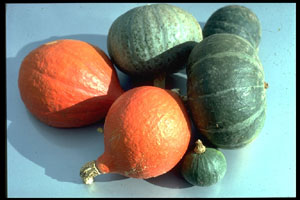
    Last winter, I did eat a few delicata squash, because Greyfox wasn't up to speed on my squash preference, and bought some for me.  After experimenting with turbans, sweet mamas, gold cups, and every other available variety, kuri is the only one I have purchased for myself for several years.  I have seen them in three colors:  red, golden orange, and blue.  The insides are all the same, only the rinds are different.

    Early in the fall, merchants usually jumble all the winter squash together into a big display at one price.  Later, when they are displayed and priced separately, blue kuri are generally less expensive than red or gold.  That may be because they are not so pretty and in less demand.  I don't care.  Since the good squash are usually gone within a few weeks, as soon as I get a chance I pick out three or four of whatever color has the best price and the fewest blemishes, and they last me through the winter.

    Blemishes are where the rot gets its start.  This year, Greyfox bought two scarred and blemished blue kuri for me, and before the end of the year I had to cull them, cut out the decomposing areas, and refrigerate the good flesh before I was ready to eat it.  I was eating squash more often than I really wanted for a while, with no help from Doug who doesn't like any squash.  Then I was inspired to bake it into a pie, with the thought that Doug might help me eat that.  He wasn't interested, and I was glad he wasn't.  Kuri pie is the best "pumpkin" pie I've ever had.  I may never buy another pumpkin.  My next jack o'lantern could be blue in the face.

    The following recipe is Kuri Pie version 2.0.  It is gluten-free, contains no cow's milk, and no added sugar.  It can be modified into a more conventional recipe, for those without my dietary restrictions.  This latest version of the quick-and-easy crust is the best yet, IMFFHO.

    In a 9-inch pie pan, stir together with a fork:

    1/2 cup sorghum flour
    1/2 cup all-purpose gluten-free baking flour
    1 teaspoon salt

    In a cup or small bowl, whisk together with your fork:

    1/3 cup vegetable oil (this time mine is soybean oil)
    1 1/2 tablespoon (4 1/2 teaspoons) goat's milk

    Pour the emulsified liquids over the flour mixture in pan, stir together with your fork, then press the mixture against the sides and bottom of the pan.  (I use the fork for spreading and pressing, then smooth it with the back of a spoon.)  Set the crust aside, preheat oven to 325°F, and prepare the filling.

    In a mixing bowl, beat:

    3 eggs

    Then add and beat together:

    1 1/2 cups cooked kuri squash (I pare it with a potato peeler, cut it in chunks, and cook in the microwave.  You could bake a whole squash [seeds removed] and then scoop the flesh from the rind with a spoon.)
    1 can (12 oz.) Meyenberg Evaporated Goat Milk or 1 1/2 cups any evaporated milk, rich milk or cream
    10 packets Splenda® sugar substitute (optional - kuri is sweet as it is, but I like it sweeter)
    1 teaspoon vanilla extract (optional - I simply love vanilla)
    2 teaspoons cinnamon
    1 teaspoon ginger
    [note:  I have hated nutmeg ever since I overdosed on it in the 1960s.  If you like it, and like the traditional pumpkin pie spices, add 1/2 teaspoon nutmeg.  Alternatively, try 2 teaspoons Chinese five spice instead of cinnamon and ginger.]

    Pour filling into prepared crust.  Bake in preheated 325°F oven about one hour.


    The less said about the weather, the better.  Last night was the coldest yet of the current cold spell.   Until this winter, I had only seen forty below zero (same in F and C scales) three times since I moved here in 1983.  The current forecast says it will be above zero here on Friday, and then colder again on Saturday.

    I spent all day yesterday feeding small splits of wood to the fire, trying to get the indoor temp above 50°F.  After I gave up and decided to bake something to warm the house a bit, the stove picked up a little and the temp got up into the mid-fifties.  After Doug started heating water on the kitchen range for dishwashing, while my pie was in the oven, all the wood in the stove went up at once and the temperature in here got up to 65°F.

    Doug turned on the floodlight by the woodpile when he went out to dump the slop bucket preparatory to dishwashing.  Hours later, it still had not lit up.  This was the first time we had tried to use it at such a low temp, and the longest it previously took to light was about half an hour.

    I woke up when he was coming through the door with his first armload of split wood.  The first thing he said to me after I indicated I was awake was, "I'm never going to do that again!"

    Ever the perfect straight man, I bit.  "What?"

    He explained that the light hadn't come on, and instead of taking a flashlight out, he decided to split wood by starlight.  There had been a bright moon earlier, but the chopping block was in shadow, and the moon had set before Doug finished dishes and started chopping wood.

    He said he jarred his hands and arms a few times hitting the wood with the handle of the maul instead of its head, but that wasn't the problem.  His glasses iced over, and he couldn't see at all.  So, he took off his glasses and that helped a little, at least enough that he could find the door and get into the house to defrost his glasses.  He is severely myopic.

    Everyone here will be glad when the weather warms up, and that is an understatement.  I have no serious complaints.  I'm happy.  My houseplants are still alive, and I have liquid water available in the kitchen.  Survival is sweet.

  • Expressing Myself


    In case anyone is curious, when I looked at the thermometer a minute or two ago it showed -33.3°F outside and 48.2°F indoors.  The outdoor temp has been steadily falling for the past four hours or so, down from -27 when I first looked today.  The indoor temp is on its way up, I hope.  I have spent a lot of time on my knees in front of the woodstove, working on the fire.

    I told Greyfox when he called that I had observed that I had gone from being snappish and testy a few days ago, to being whiny today.  He misinterpreted what I said.  That's one of the benefits I get out of our relationship:  I am continually challenged to express myself more precisely and accurately.

    He thought I meant that I had gone from being angry to being depressed.  That is way off the mark.  I was happy when I was snappish and I'm happy now, even though my speech sometimes comes out in a whine and occasionally I hear myself whimper.  I'm not bouncy or bubbly, but I'm happy.  I'll leave the bouncing levity to Ren and Stimpy.

    When I was short-tempered and snappish the other day, I had been short of sleep for several days and had been dealing with a bunch of restless cats and a big husky dog with cabin fever.  The cold temperatures were causing my muscles to spasm.  Physically, I was challenged.  Mental energy was going into coping with that.  The strain came out in impatience and sharp responses.  I was fatigued.  If I had been angry in addition to the fatigue... well, I don't want to go there.

    These past three nights I have gotten more sleep, between six and seven hours a night.  The cats have caught onto the fact that they are prime targets for stun darts from the blowgun while hanging off my Navajo rug, and they even seem to realize now that I don't have a door into summer for them.  Maybe they have some hibernation instinct.  They are quieter this week.

    Koji got to check his p-mail on a walk to the mailbox with Doug yesterday while the temp was up in the teens below zero.  He's not as restless today, not dogging my heels, whining at the door, or poking his cold, wet, black leather snoot at whatever part of me it can reach..  That lets some pressure off me, and I'm not feeling snappish today.  When I was being snappish, as opposed to just feeling that way, it was unconscious.  When I caught on to what was going on, I quit snapping at Doug.  There was nothing to be gained by taking it out on him.

    My whining today has nothing to do with depression.  I know depression, and this is not it.  This is simply M.E., the tight and unresponsive muscles, the random traveling pain and all-over discomfort.  That time this morning when I caught myself whining, that was unconscious.  *chortle*  I just attempted to whine voluntarily.  It sounded phony and silly. 

    Maybe I needed to hear myself whimper this morning.  I don't know.  I don't think the cats or Koji paid any mind to my whine.  I probably didn't affect the discomfort by whining, but I might have increased it by making an effort to suppress it.  I'm pretty sure that sitting here in this draft is making my legs cramp.  I think I'll test that theory by gimping over to the couch, putting my feet up and spreading the 3 blankets there over my lap. 

    First, I have something to share, some words by a favorite writer and astrologer, Mark Krueger, excerpted from his December 23, 2008 entry:

    Who you are is non negotiable. Who you are is not an attainment or purity. Who you are is not a gift or a lick and a promise. Who you are is your own being. The rest is dream spinning software of allure and a lore. The soul is the file of the stories. The body is the stylus. What is written is nothing more than an itch-a-sketch. You get drawn in for a drawn out affair of the heart that heads no where whilst you turn the knobs of yen and yank. Every time you try to get out, you are deeper in.
    . . .

    It's all loss all the time for the next fifteen years of wild abandonment. It's dearth warmed over in the macro wave. All you ever gain is the loss of your self, and trinkets to boot. Now that the trinkets go bye bye, who ya gonna cull. People own a bag of shift, a bag of shift that never did work, but it surely worked them. Got the gumption to drop it? I dare you to your own delight. Otherwise, what I see is Pathetic mumboed jumble.


  • Our weather is not so bad, really.

    The cold snap has, until today, not actually made news here.  It was talked about on the weather shows and among neighbors and family, but not on the straight newscast.  Tonight, though, I heard that we here in the valley haven't had it so bad.

    In interior Alaska, Tuesday is day ten of the current cold spell.  It hit them a few days before it got here.  For the past four or five days, while we have had temps from the mid twenties below zero to around forty below, they have been having steady daily temps around sixty below in Chicken and Fort Yukon.  Fairbanks has been a few degrees warmer than that, if you can apply the word, "warm" to minus 55°F.

    After getting up to minus 17° here today, before dark it had gone back down to around -23° along with the rise in barometric pressure I mentioned earlier.

    Anchorage is never as cold as here or the interior.  It is lower in elevation and latitude, and gets some warmth from the water.  But for them the current cold spell has been more than simply inconvenient.  They had planned a big celebration of the 50th anniversary of statehood on Friday and Saturday, and they are holding the first world championship Nordic skiing competition.  Some events have been postponed, others were canceled.

    Tonight's weather forecast said the cold will continue at least through Thursday.  I'm in no danger of running out of firewood yet, but that pile doesn't look nearly as big as it did when I put the tarp over it this fall.  I'm glad I ordered more than I thought I'd need.

  • My First Professional Gig

    I never set out to become a professional psychic.  I had no desire to gain fame as a Tarot card reader.  It just seemed like a good idea at the time.

    The time was the summer of 1976.  Alaska, which had always had a boom-and-bust economy, was enduring a severe bust following the construction boom of the Trans-Alaska Pipeline.  Charley and I had both been out of work for over a year, well beyond the end of our unemployment compensation.

    We made the rounds of Anchorage dumpsters as often as we had enough money to buy fuel for our VW bug.  We could reliably find out-of-date bread, eggs, and dairy products behind the Carr's store nearest us, and even nearer to home was a Bi-Lo that left discarded meat in a barrel outside the back door.  Most of its beneficiaries were dog teams, but we did not hesitate to grab for ourselves a pork loin or shoulder of beef if it was only green on one end.  In summer, vegies came from my garden and from wildforaging in the woods.  In winter, greens came from the sourdough's standby:  alfalfa and clover sprouts.

    Various other dumpsters provided us with just about any kind of mongo, small and large.  If it was too large for our bug, we'd get our neighbor Marty, who was a scavenger of longstanding and large scale.  He'd drive his truck to help us pick up construction debris, empty barrels, etc.  If we didn't have a need for the stuff, we'd sell it at the flea markets held in Anchorage's Sports Arena one weekend a month.  Organized recycling, at the time, was unknown in Anchorage.

    Each morning, Charley went for coffee at Denny's, where contractors gathered for breakfast.  He was hoping for steady construction work, but that didn't come.  Mostly he just learned where there were jobsites we could clean up for the scrap.  Occasionally, he'd pick up some temp work, too.  One day he came home with a small ad torn from a newspaper.  He was grinning when he showed it to me.

    The heading read:  "CALL FOR VENDORS & PERFORMERS!"  They were looking for participants for the first Girdwood Forest Fair.  They wanted artists and artisans, musicians, singers, dancers, actors, jugglers, acrobats, magicians and fortunetellers.  I told Charley, "I'm not a fortuneteller!"  He said, "I know that, but they don't."  It was an old topic of discussion, and it came up almost every time my cards came out at a party. That was whenever I could find someone willing to let me read for them. 

    I was a true amateur, a lover of the art.  A shy loner like many other only children, in reading cards I found an ideal ice breaker.  Never able to bring myself to engage in small talk and ask the innocuous personal questions that lubricate social interaction between strangers, I was enabled by the cards to tell people things about themselves that they had been sure nobody else knew.  A thousand times, at least, in the seven years that I had been practicing, I had said, "Fortunetellers tell people what they want to hear.  I tell you what you need to know."

    It took Charley a few minutes to convince me.  The booth fee was $30.00, and it was forty miles or so to Girdwood.  I was afraid we wouldn't make back our expenses.  He insisted that it was worth a shot.  Over our years together, to my everlasting benefit, Charley convinced me that a lot of things would be worth a shot.

    I got on the phone and made the commitment to be there on the Friday before July 4th to set up a booth for the weekend.  The festival, I was told, would be held in the park behind the village fire hall in Girdwood.  I knew the place because we had camped in the park and had gotten water from the outdoor faucet at the fire hall.  We already had a "booth."  It was a collection of salvaged lumber and reused nails that we had been using for our flea market booth.

    On the day, we were among the first to arrive.  Three other groups of people were scattered around among the trees, hammering away at booths.  Another bunch of guys, supervised by a young woman, were setting up a flat bed trailer to be used as a stage.  I picked a spot with some reasonably flat ground between the tree roots.

    Charley and I put together our eight-foot square frame easily and quickly after months of practice.  We covered the walls with India print bedspreads and the top with poly sheeting.  The furniture was a piece of scrap plywood laid across an old fruit crate for the table, and floor cushions for seating.  When construction was done, we wandered around, lent a hand with some other boothies, and got acquainted.

    Saturday morning, I sat there on my pillow and watched two young women in a kissing booth across the way, making money as fast as they could kiss, at two bucks a pop.  There were a dozen or more booths, most of them crafters or artists.  Most of those people would become my friends within a year or two, but I never saw the kissing girls again, except once at a laundromat when one of them called me a bitch, but that's another story.

    The morning passed in idleness for me.  A few people passed by and asked Charley, my doorkeeper and body guard, how much I charged.  He explained that I followed a tradition of not setting a price on my readings, but would accept donations.  It was an awkward spiel and he soon condensed it to, "Whatever you think it's worth after you hear it."

    I did my first reading in early afternoon when someone came in to get out of a sudden rain shower and felt awkward about just standing there under my roof.  My reading blew his mind and he went away and talked about it.  Business picked up.  I was there that evening long after the kissers got too drunk to stand there any longer.  Charley had to send a couple away when the light grew too dim for me to read the cards.  The next day, there were people waiting for me when I crawled out of my sleeping bag.

    There were people waiting to get into my booth all day Sunday.  Charley dragged over some straw bales from around the stage for them to rest on, and spent his time entertaining them or luring in others by telling them, sincerely, how good I was at what I did.  He'd been watching over my shoulder and listening in for a few years, and the cards had blown his socks off a few times.  If someone hesitated, he'd say, "It's painless."

    Other boothies found time to come over for readings, and if they were in a hurry to get back, Charley let some of them jump the line.  I happily accepted barter, including hand-knit socks, a hand-thrown mug, a stained glass suncatcher, and an endless supply of grilled sausage, onion and pepper subs, in exchange for readings.  Our cash profit was a bit over $300.00, ten times our investment.  We were hooked.

    The guys who had the sub booth did it again at a few more Forest Fairs, until they got the financing to open The Marx Brothers' Cafe in Anchorage.  They told us to come by any time we needed a free meal.  I started setting up my crate and pillows in the back of the flea market booth, and expanded to a summer round of festivals all over Southcentral Alaska.

    Wherever I went, I was at first the only psychic working there.  Christian fundamentalists would protest to the organizers and promoters, and twice my reservations were cancelled and my deposit returned:  by an Anchorage civic group for an event at the Hotel Captain Cook (I typed "Hotel Captain Hook" first, a popular old sobriquet), and by the University of Alaska for their Arts Fair.  Others, including Girdwood, didn't cave in to the pressure, and within a few years other psychics were coming out for the festivals.

    The fair and its park changed.  Tennis courts, swing sets, gravel picnic pads and paved paths were put in.  A permanent stage and sound booth replaced the old flat bed trailer and rickety lean-to.  My favorite pad was reserved for me every year.  Crowds grew bigger and signs went up:  "No dogs or religious orders allowed."

    At the sixth annual Girdwood Forest Fair, one nervous paramedic or another would drop by every half hour or so to ask me how far apart my contractions were, but I knew they were only Braxton-Hicks contractions.  Doug wasn't born until three weeks later.  The following summer, and the one after, I held him on my lap and nursed him while I read cards.  I was an activist for bringing breastfeeding out of the closet, just as I was for psychic reading.

    In Girdwood, sometime around 1990, the year that there were nine psychics working, it was the last straw for the fundies.  They showed up en masse at a village council meeting that winter and demanded that we all be ejected permanently.  I heard about the flap second and third hand.  People went to bat for me. 

    The compromise that was reached was that everyone else would be barred, but I would be grandfathered in for as long as I kept showing up, because I had been there from the first.  If I ever stopped, nobody would be allowed to take my place.  I kept doing the Forest Fair until 2001...   or '02, when I wasn't physically able any longer.  One organizer who had been there from the start pleaded with me, offered assistance, wanted so badly to keep the tradition going, but I had to express my regrets and stay home. 

    Media have reported that there will be no Girdwood Forest Fair this year.  Insurance expenses, protests from villagers disturbed by the crowds, traffic, drunks shooting fireworks and passing out in their yards, etc., brought it down at last.  It was good while it lasted, the Goodwood Fair, the Rain Forest Fair... my first.

    This is my response to the first of two Featured_Grownups topics for January of 2009:  First of All....

    ...to blog about a first. It can be any first: first tooth, first step, first boyfriend/girlfriend, first time, first spouse, first child, first time to conquer the world in some alternate gaming universe.

  • Warmer Weather Here

    This morning, the temperature has been hanging right around minus twenty-three.  It's still a little colder than I can comfortably breathe outside, but it is much warmer than the minus thirty to forty we have had here for the past four or five days... or has it been longer than that?  It seems longer.  A day ago, the cabin fever got to us, and Doug and I were snapping at each other a bit in the morning before we talked it through. 

    Koji and the cats are taking it worse than we are.  The big hairy guy stands in the corner where his leash and head collar are hanging, whining to go check his p-mail.  No way is Doug going to take him out at 30+ below zero, and on those occasions when we let him out on his chain, he wastes no time getting back in here.

    The little furries are climbing the wall hangings, the book cases, the kitchen cabinets, etc.  Friday evening, as I was letting Koji in off his chain, Colander ("Linda") Piebean ran out.  She came back and Doug let her in sometime Saturday night.  The only sign of frostbite was the tip of one ear.  Granny Mousebreath has one tanto-bladed ear, from a frostbite that occurred before we moved in here ten years ago to housesit and care for her and her family.

    The barometer here dropped from 30.56 to 29.04 over the course of five days.  Then, from about midnight last night to now, it has gone back up to 29.38.  Google weather shows forecasts of slightly colder weather Tuesday and Wednesday for Willow and Talkeetna (we're between them).  It also shows both of them warmer than we are right now.  Wasilla's weather appears to be in a warming trend.  Greyfox said it was above zero when we talked last night.

    Much of my attention has been focused on keeping a fire going and not letting the coals-and-ash buildup in the firebox come cascading out when I open the door.  We need a day of above zero weather so I can let the fire burn down and shovel out the ashes.

    I still have not made up my sleep deficit, but it is holding steady.  I get between five and seven hours a night now that Doug's sleep cycle is moving more out of sync with mine.  Today, when I moved out of my bed, he got in.  It doesn't get any better than that.  Yesterday, I had to wake him and move him to my bed so I could use Couch Potato Heaven and the PS2.

    That's going to be my next stop, after I make and eat some gluten-free sorghum flour and buckwheat pancakes... or maybe I'll sit down here again for a while before I get back to chasing the Mandragora family around the Feywood.

  • Neurochemistry of Addiction and the Role of Prostaglandins in Alcoholism - UPDATED

    The ancient Greeks preached, "moderation in all things."  It is reasonable to infer from such preaching that they were experienced in the hazards of immoderate behavior.  To Greeks of the Pythagorean school, temperance, moderation, or the "mean" between two extremes -- the reconciliation of opposites -- was believed to create harmony.  That's a pretty theory, I will admit.  When it comes to practical reality, however, time and again in the centuries since the Golden Age of Greece, the theory has failed to prove itself valid.

    I would challenge anyone to preach moderation at an AA or NA meeting.  Experienced drunks and dope fiends know that path won't work for them.  In the quest for moderate drug use, many have died.  In AA's "Big Book" one essay lists the ways an alcoholic might try to moderate his drinking with strategies such as drinking only at home, drinking only beer, only after five, etc.  Whenever that list is read at a Big Book meeting, it is greeted with the rueful laughter of those who have tried some of those things themselves.

    Among the routine readings at the start of each of our NA meetings is this:  "The only way to keep from returning to active addiction is not to take that first drug.  If you are like us you know that one is too many and a thousand never enough.  We put great emphasis on this, for we know that when we use drugs in any form, or substitute one drug for another, we release our addiction all over again."

    David F. Horrobin has explained why alcoholics cannot moderate their drinking.  I have extracted here some results of his work, taken from Chapter 11 of Mary Greeley's book, Alcoholism as an Allergy:

    Prostaglandins (PGs) are powerful chemicals found in every cell of the body.  They appear to be key controlling factors which regulate the way every organ works.  There are at least 20 of them, each with a specific function.  They are being constantly produced just when needed and then are instantly destroyed so their effects are not too prolonged.  

    PGs come in three families, all formed from relatively stable chemicals called essential fatty acids (EFAs).  EFAs are like vitamins, they cannot be made in the body and must be provided regularly in food.  Every body cell has an EFA store and when PGs are needed, EFAs are brought out of storage.... rapidly converted to PGs which briefly exert their effects and then are destroyed....  

    PGE1 is formed from an EFA known as dihomo gamma linolenic acid (DGLA).  PGE1 can open blood vessels which have gone into spasm, reducing the amount of damage due to a heart attack, and possibly even prevent heart attacks.  PGE1 can also lower high blood pressure, and reduce cholesterol production in the body.  PGE1 can stimulate a poorly functioning immune system, block inflammation and control arthritis.  PGE1 has dramatic effects on the Central Nervous System and behavior.  PGE1 added to cancer cells in the laboratory can make them function like normal cells.

    EFAs, DGLA, cLA and GLA
    The Pump and the Alcohol Converter

    Limited amounts of DGLA, the EFA from which PGE1 is made, is found in most cells of the body and PGE1 is produced from it by two main steps:

    1)  The DGLA has to be removed from storage in a free form, and,
    2)  The free DGLA has to be converted into PGE1...."

    Following published research by Dr. Joe Abdulla of Guy's Hospital, London, on the formation of PGE1 by platelets taken from patients with various forms of mental illness, Dr. Horrobin (noting similarities between mania and early stages of alcohol intoxication) studied the effects of alcohol on platelets.  Independently, Dr. John Rotrosen of NYU's Dept. of Psychiatry and the Veteran's Administration Center, did almost the same experiments.  Both experimenters concluded that, "alcohol at concentrations relevant to human drinking has a potent effect on PGE1."

    Many of the effects of alcohol and almost all of the good ones are due to the increase of PGE1 formation and this can explain the behavioral effects of alcohol.  PGE1 has profound effects on behavior, and behavioral changes in animals can be blocked by preventing the alcohol action on PGE1.

    Facial flushing produced by alcohol has a similar effect as produced by PGE1.  This effect can be blocked by drugs which block PGE1 formation.  The desirable effects of alcohol in reducing the risk of death to diseases of the heart and circulation are similar to PGE1.  Alcohol may possibly lower the risk of infections, as witnessed by travelers to the tropics, and by the traditional remedy of a hot alcoholic drink for flus or colds.  PGE1 is able to stimulate weakened immune systems, and to help them resist infections.  It is certainly not beyond the bounds of possiblity that alcohol, like vitamin C, which acts much the same way, could have a protective effect.

    With so many good actions to PGE1's credit, how is it possible that something which increases the production of the prostaglandin could have so many bad effects?  Surely, it would seem taking more of a good thing should be even better, but this is not true.  For one thing, DGLA stores within cells are limited.  Stimulation of PGE1 formation by alcohol cannot go on forever.  Eventually the stores become depleted and even if alcohol is still present, PGE1 levels will fall catastrophically, far below normal....

    ...alcohol, beyond depleting DGLA stores, has another effect which compounds the damage.  There is very little DGLA in foods.  The exception is human milk.  Therefore, we have to make DGLA in our bodies from another nutrient, cis-Linoleic Acid (cLA) which is particularly in vegetable oils.  Most of our PGE1 is ultimately formed from cLA in the diet.  The cLA must first be converted to a substance called Gamma Linoleic Acid (GLA) itself....

    Alcohol temporarily increases PGE1 formation by stimulating its production from DGLA, but in the process DGLA stores are depleted.  In a normal person, such stores could be rapidly made up from the cLA in the diet.  But the person who drinks too much alcohol cannot do this because the conversion of cLA to GLA is blocked so that paradoxically, chronic overconsumption of alcohol leads to a chronic deficiency of PGE1.  This lack of PGE1 may then lead to an increased risk of heart attacks and stroke, to high blood pressure, reduced ability to cope with infections, to brain and nerve deterioration and liver damage.

    How much is "too much" varies from person to person.  Variables in genetic makeup and diet, as well as such factors as exposure to other toxins, make such an assessment unpredictable.  People starting out with low levels of PGE1 are most likely to quickly become alcoholics, but alcohol's blocking of conversion of cLA to GLA will, at some point, begin to lower anyone's PGE1 levels.

    A perfectly normal person readily able to cope with alcohol and not depressed before or after drinking, may become alcoholic.  His PGE1 levels in the absence of alcohol are normal, but gradually repeated drinking depletes his DGLA and simultaneously prevents its replenishment from cLA.  The resting level of PGE1 drops, a depression develops in the absence of alcohol and increasing amounts are required to get the PGE1 level up to normal.  Before he knows what he is doing, the social drinker is drifting into alcoholism.  He is drinking more and more of a substance which transiently and with increasing difficulty brings PGE1 up, but at the same time progressively destroys the body's ability to make PGE1. [emphasis added]

    Dr. Horrobin's recommended treatment for alcoholism is twofold:  first reducing the cravings, and then avoiding or reversing the damage from the lack of PGE1.  He does not address a way to reduce cravings.  Many doctors do it with toxic drugs such as antidepressants.  We do it with orthomolecular supplements of amino acids, vitamins and minerals.  We also follow Dr. Horrobin's recommendation for increasing PGE1:  evening primrose oil for GLA, with cofactors B6, B3, pyridoxine, niacin, zinc, magnesium, and vitamin C.

    With other drugs besides alcohol, other prostaglandins are involved.  However, in any addiction, even those to activities and processes as opposed to substances, there are similar biochemical cycles:  the addiction stimulates some pleasurable or beneficial effect while at the same time depleting the chemistry involved in making that happen.  Here is the way nutramed.com describes some common food addictions:

    We notice similar patterns of addictive behavior with food, alcohol and drugs. Alcoholics and drug abusers frequently have atrocious dietary habits. So many of them grew up dysphoric with bad chemicals in their food and environment. These addicts often report they first felt well when they had their first drink or injected the initial dose of heroin. Opiates, like other molecules, are effective but temporary remedies for dysfunctional body-mind states. The drive to maintain an opiate level is less to "get high" and more to feel "normal" and mostly to avoid the terrible experience of withdrawal.

    The digestion of food proteins may produce substances having opiate or narcotic properties. There are also a large number of regulatory peptides feeding back to brain control centers to form the brain-gut axis. A stop signal to the brain when enough food is eaten would be important for appetite control and may be defective in compulsive eaters.

    Exorphins

    Pieces of milk and wheat proteins (peptides) can act like the body's own narcotics, the endorphins, and were described by Zioudro, Streaty and Klee as "exorphins" in 1979. Other food proteins, such as gluten, results in the production of substances having opiate- (narcotic) like activity. These substances have been termed "exorphins." Hydrolyzed wheat gluten, for example, was found to prolong intestinal transit time and this effect was reversed by concomitant administration of naloxone, a narcotic-blocking drug. Digests of milk proteins also are opioid peptides. The brain effects of exorphins may contribute to the mental disturbances and appetite disorders which routinely accompany food-related illness. The possibility that exorphins are addictive in some people is a fascinating lead which needs further exploration.

    Another mechanism, similar to dependency on food-derived neuroactive peptides such as exorphins, would be a dependency on gastrointestinal peptides, released from the bowel during digestion. Deficiencies in the bowel production of regulatory addictive peptides, such as endorphins, would likely be associated with cravings and compulsions to increase food ingestion. There are a large number of gut-regulatory peptides feeding back to brain control centers to form the brain-gut axis. The information flow between the gut and brain is likely critical in regulating feeding behaviors.

    Eugenio Paroli reviewed the peptide research, especially the link between food and schizophrenia. He suggested: "The discovery that opioid peptides are released by the digestion of certain food has followed a line of research that assumes pathogenic connections between schizophrenic psychosis and diet."

    Milk and wheat proteins have been studied and shown to yield active peptides. These substances may be numerous in the digestive tract after a meal and several effects could occur in sequence. The absorption of larger peptides may be irregular, with variation in symptom production after meals, making the interpretation of milk and wheat disease difficult. Other foods are likely to yield similar peptides.

    From our basic understanding of protein digestion, we should predict that there will be regular traffic of peptide information passing from food digests into the body. Ingestion of normal food may result in information-molecules streaming into our bloodstream from stomach or small intestine with all the impact of narcotic drugs! A "Gluten Stimulatory Peptide" is also described with narcotic (opiate) antagonist properties. It has been suggested that gluten hydrolysates, digests of wheat protein, have mixed opiate agonist-antagonist activity and, like two drugs with mixed narcotic activating and blocking actions (nalorphine and cyclazocine), produce dysphoria and even psychotic symptoms. Loukas and colleagues have derived the structure of cow's milk-derived exorphins: Opioid activities and structures of casein-derived exorphins. These two peptides carry information by finding and binding to brain receptors which ordinarily respond to endorphins. The message is go to sleep, feel bad, but go back for more.

        Arg-Tyr-Leu-Gly-Tyr-Leu-Glu (exorphin, digested from alpha casein)

        Tyr-Pro-Phe-Pro-Gly (exorphin, digested from beta casein)

    Chocolate

    Chocolate is an interesting psychoactive food. Chocolate and romance have been inseparable. Chocolate artistry is one of the truly admirable pursuits in food preparation. If nature had been more kindly disposed to us, chocolate confections would be an authentic pleasure, free of any penalty. Chocolate begins as the cacao bean of South American origin. The botanical name, Cacao Theobroma, means "food of the Gods". One of the medically useful methylxanthine drugs, theobromine, is found in chocolate as well as coffee and tea. Theobromine is related to caffeine and is useful as a treatment of asthma.

    The cacao tree produces melon-sized pods full of beans. The pod is split and the beans removed and fermented until they turn the characteristic deep brown color. Dried beans are then roasted and processed by grinding and heating. The powdered fraction is the water soluble cocoa powder. The bean fat is separated as cocoa butter. Chocolate candies are all based on some combination of cocoa powder, cocoa butter, milk, sugar, and diverse other ingredients. Drugs in the cocoa powder make chocolate addicting. Chocolate enthusiasts often admit they are addicts and find it difficult to resist cravings and binge with unpleasant consequences. Chocolate confections are complex mixtures of milk, sugars, nuts, flavors, including cinnamon and other spices; they present drug and allergenic effects simultaneously. Post chocolate symptoms include anxiety, migraine headaches, abdominal pain, joint pain, mental agitation and depression. Chocolate addiction is more socially acceptable than it is healthy. Some chocolate eaters become quite ill and quite obese.

    Women often report chocolate cravings in the premenstrual week. Chocolate also serves as a surrogate for companionship or affection. The addictive molecules in chocolate include caffeine and another speed-like drug, phenyethylamine (PEA). PEA is related to our own catecholamine neurotransmitters and their amino acid precursors, tyrosine and phenylalanine. PEA has arousal properties similar to catecholamines and may be one of the pleasure substances in the brain. PEA has been called the "love drug". Most PEA absorbed from the bowel is destroyed in the blood or liver by the enzyme MAO-B.

    Coffee and Tea

    Coffee makes us speedy, irritable, sleepless, and often causes heartburn or ulcers. The removal of caffeine is supposed to reduce some of these undesirable effects. Coffee is an addicting beverage. If you consume more than 2 cups per day, you are likely to experience unpleasant withdrawal if you stop. The minimal suffering includes a headache, irritability, and fatigue. The popular idea that the bad effects of coffee are caused by one chemical, caffeine, is misleading. The 500 or so other chemicals in coffee include aromatic or phenolic chemicals and many are probably neurotoxic; other chemicals are allergenic. Coffee is also a crop with high pesticide residues. Coffee is definitely allergenic and makes some people obviously sick. Chlorogenic acid is one of the allergens which coffee shares with oranges.

    Black Tea and coffee have much in common, although they different plant products from different geographic zones. Tea contains caffeine and other members of the drug family, methylxanthines. Tea also contains tannin, a good tanning agent. The caffeine dose in a cup of coffee ranges from 100 to 160 mg. A cup of tea has 20-60 mg per cup and 12 ounces of regular Coca Cola has 45 mg of caffeine. The symptom complex produced by tea parallels coffee, although overall, tea is milder and better tolerated. Green teas are the mildest of the caffeine drinks and have beneficial phytochemicals which make their use more attractive.

    Daily coffee ingestion induces a 24 hour cyclic disturbance with morning arousal, irritability, difficulty concentrating, subtle levels of disorganization, clumsiness, and forgetfulness. As the day progresses, 3 or more cups later, a heavy fatigue sets in by mid to late afternoon. Further coffee doses may rouse one a bit, but then further collapse is inevitable by evening. Irritability may evolve into disproportionate or inappropriate angry outbursts, pleasure-loss, absence of good-feelings, or empathy anesthesia.

     It is likely that the subtle pyschopathology of moderate to heavy coffee consumption contributes to the production of unnecessary conflict and dysphoria. The subtle cognitive and memory deficits which appear after coffee intake should alarm employers who expect their employees to think, remember, or carry out skilled, coordinated acts. It may be that coffee facilitates dull, routine, rote tasks where thinking, skill and initiative are unimportant.

    Under the circumstances, knowing what I know of addiction from firsthand experience and the shared experiences of other addicts, as well as from biochemical research, I would never recommend even moderate consumption of addictive substances.  I have noticed that most if not all of the people who do recommend such moderate consumption have an axe to grind, usually the defense of their own addiction, which they are reluctant to relinquish.

    Unfortunately, many of those I see doing such defending are educated and aware addicts who go way out of their way to avoid illicit drugs but will not consider what the legal drugs they've substituted are doing to their biochemistry and their health.  Far too many of them, and of other Americans without drug addictions, are morbidly obese from their addictions to foods.  Thus they make of their abstinence and recovery a difficult white-knuckle experience, filled with temptations and cravings.

    Nutritional supplements, including vitamins, minerals, essential fatty acids and amino acids make it painless and reasonably easy to transcend any addiction, even those involving activities such as sex and gambling, when the supplements are used with an awareness of which neurochemicals need to be increased and which supplements do what.  The websites, Mood Cure and Diet Cure, and the book, End Your Addiction Now by Charles Gant and Greg Lewis, provide checklists that help one diagnose neurotransmitter imbalances.  End Your Addiction Now, and the books, Mood Cure and Diet Cure by Julia Ross, also contain information on which supplements will rebalance specific deficiencies. 

    If you are too lazy to research it and heal yourself, and you have lots of extra money or health insurance that covers addiction treatment, and you go to an internist for treatment, you are likely to be given drugs that are addictive themselves and/or will only make the neurotransmitter imbalances worse.  If your insurance also covers orthomolecular medicine, an orthomolecular physican can do the diagnosis for you and recommend the necessary supplements.

    There are many healthful and long-lasting ways to stimulate the production of beneficial biochemicals such as PGE1 and the pleasure neurotransmitters such as dopamine.  These include physical activity, learning new information or skills, and creative expression.  Many people find all the "highs" they desire, simply by being of service to others.

    Forget moderation.  Throw yourself wholeheartedly into your healthy creative outlet, your charitable work, or your pursuit of knowledge.

    "The only way to keep from returning to active addiction is not to take that first drug."
     

    Originally posted, in slightly different form, at 3:24 PM, 12 May, 2007.

    If you have found this essay helpful and/or encouraging, and wish to bring it to the attention of others, use the "share" or "email" link below, give it 5 stars by clicking the star on the far right end of the strip of stars, and/or click the "recommend" link.